Executive leadership challenges rarely arrive neatly labelled.
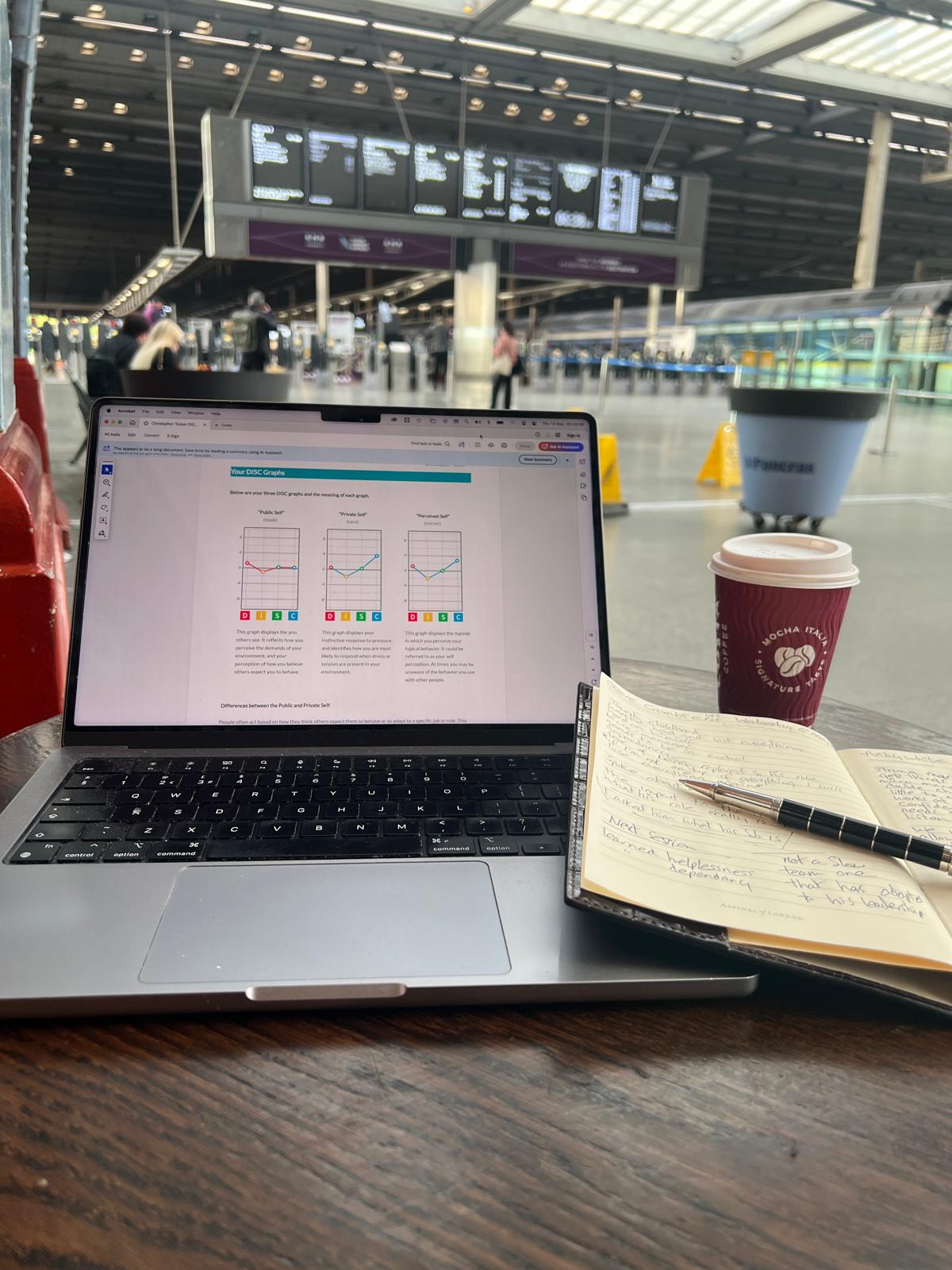
Sitting in St Pancras before two coaching sessions in Derby, I found myself reviewing leadership feedback, behavioural patterns, and notes from previous conversations.
From the outside, it probably looked like preparation for another normal working day.
Coffee. Laptop open. Train announcements in the background.
But executive coaching is rarely just about diaries, performance metrics, or action plans.
Most leadership challenges don’t arrive neatly labelled.
They rarely walk into the room introducing themselves clearly.
Instead, they tend to show up disguised as pressure, fatigue, frustration, conflict, over-functioning, or silence.
A leader says they are struggling with workload.
Another says their team is becoming dependent on them.
Another talks about communication problems, low patience, lack of motivation, or feeling disconnected from the role they once enjoyed.
On the surface, these can look operational.
But often, something deeper is sitting underneath.
Sometimes it is the pressure of increased responsibility.
Sometimes it is the transition from being the person who delivers the work to the person responsible for leading others through it.
Sometimes it is exhaustion hidden behind competence.
Sometimes it is identity.
And sometimes, it is the weight people have been carrying for so long that they no longer recognise it as weight at all.
One of the patterns I see regularly with senior leaders is over-functioning.
Highly capable people who have spent years being rewarded for stepping in, fixing problems quickly, carrying more than others around them, and operating at speed.
Over time, that strength can quietly become the very thing creating pressure.
Not because they are incapable.
But because the system around them slowly adapts to their ability to absorb everything.
People rarely walk into coaching saying:
“I think I’ve created a culture where everybody relies on me.”
They usually say:
“I’m exhausted.”
Or:
“I don’t understand why nobody steps up.”
That distinction matters.
Because leadership development is rarely about simply learning another model or communication technique.
More often, it involves helping someone see what has been hidden in plain sight.
At senior levels especially, there are fewer places where leaders feel able to pause long enough to think clearly about what is really happening underneath the surface.
The expectation is often to remain composed, capable, decisive, and constantly moving forward.
But pressure has a way of leaking out eventually.
Into decision-making.
Into relationships.
Into communication.
Into home life.
Into health.
Into how people experience the leader around them.
That is why some of the most important work in executive coaching begins before anyone even walks into the room.
Not with answers.
But with observation.
Patterns.
Preparation.
And the willingness to look beyond the obvious presenting problem.
Sometimes a train journey and a quiet hour of reflection before a session tells you more than the spreadsheet ever will.